Showing posts with label hardware. Show all posts

Tuesday, September 6, 2011

Quantum optical link sets new time records

From physorg.com

Image Source: physorg.com
Advice to young people interested in cutting-edge computing: take lots of physics! So many interesting physics news items... so little time to comprehend.
"Quantum communication could be an option for the absolutely secure transfer of data. The key component in quantum communication over long distances is the special phenomenon called entanglement between two atomic systems. Entanglement between two atomic systems is very fragile and up until now researchers have only been able to maintain the entanglement for a fraction of a second. But in new experiments at the Niels Bohr Institute researchers have succeeded in setting new records and maintaining the entanglement for up to an hour. The results are published in the scientific journal Physical Review Letters."

Monday, August 29, 2011

IBM's moves toward quantum computing

From Computerworld

Image Source: zmescience
IBM, one of the most patent-rich companies in the world, continues it's amazing pace of research and innovation. The future, they believe, is in a radically different paradigm of computing hardware (which will also require new thinking in software approaches as well).
"But the computing industry is moving to a new future as disruptive and as radical as the era that began with the introduction of silicon chips, and that future is quantum computing. These are systems that use the behavior of subatomic particles to conduct calculations now performed with transistors on a chip."

"An ordinary computer is a collection of bits that can either be a 0 or a 1. But quantum bits can hold those states, 0 and 1, simultaneously. Instead of doing a calculation one after the other, the processing power in a quantum computer can increase exponentially. Two quantum bits, or qubits, can hold four distinct states, which can be processed simultaneously, three qubits can hold eight and 10 qubits can hold 1,024 states. In time, researchers expect machines with thousands of qubits."

Sunday, August 28, 2011

Data are traveling by light

From Fraunhofer-Gesellschaft

My favorite part of the article: the use of the word "ensconced." A visible light WLAN might be kind of impressive, but if the users are also ENSCONCED in a room, well then that's just amazing!

Joking aside, this is an interesting approach to networking that doesn't rely on traditional radio signals.
"Just imagine the following scenario: four people are comfortably ensconced in a room. Each one of them can watch a film from the Internet on his or her laptop, in HD quality. This is made possible thanks to optical WLAN. Light from the LEDs in the overhead lights serves as the transfer medium."

'via Blog this'

Friday, August 26, 2011

A Day Made of Glass

From Corning.

This video shows some cool possibilities for near future tech. It's more than five minutes long, but engaging and worth it.


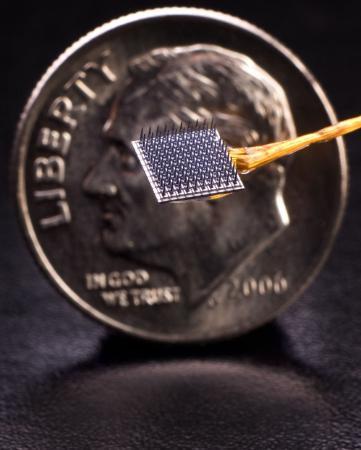
BrainGate neural interface system reaches 1,000-day performance milestone

From Brown University News and Events

Image Source: Brown Univ
An interesting milestone in machine/human integration. The system described is being used to replace functionality lost to tetraplegia, but as with any such system, it could someday be used to give unimpaired people extra abilities.
"An investigational implanted system being developed to translate brain signals toward control of assistive devices has allowed a woman with paralysis to accurately control a computer cursor at 2.7 years after implantation, providing a key demonstration that neural activity can be read out and converted into action for an unprecedented length of time."

"Under development since 2002, the investigational BrainGate system is a combination of hardware and software that directly senses electrical signals produced by neurons in the brain that control movement. By decoding those signals and translating them into digital instructions, the system is being evaluated for its ability to give people with paralysis control of external devices such as computers, robotic assistive devices, or wheelchairs. The BrainGate team is also engaged in research toward control of advanced prosthetic limbs and toward direct intracortical control of functional electrical stimulation devices for people with spinal cord injury, in collaboration with researchers at the Cleveland FES Center."

Wednesday, August 11, 2010

GPUs Threaten Password Security

See original at Georgia Tech Research Institute

Earlier this year I saw a story about how the US Air Force used PlayStation 3 consoles to build a supercomputer "100,000 times faster than high-end computer processors sold today." The power comes from the PlayStations' graphics processing units.
"It's been called revolutionary - technology that lends supercomputer-level power to any desktop. What's more, this new capability comes in the form of a readily available piece of hardware, a graphics processing unit (GPU) costing only a few hundred dollars.

Georgia Tech researchers are investigating whether this new calculating power might change the security landscape worldwide. They're concerned that these desktop marvels might soon compromise a critical part of the world's cyber-security infrastructure - password protection."

Saturday, February 13, 2010

Programming methods for multicore

There have been many advances in programming paradigms (functional, object-oriented) and programming methodologies (agile, extreme); but much development is still done with a single or a small number of processors in mind. This has to change in order to take advantage of the power of multicore machines. Researchers at Berkeley are aiming to change this by developing new parallel methodologies.
Using [their] approach, one team created a program that reduced the time needed to create an MRI image from one hour to one minute. The code is already being used at a local children's hospital.
In another example, the approach reduced the time to handle object recognition from 222 seconds on an Intel Nehalem processor to 1.8 seconds on a massively parallel Nvidia GTX 280 chip. Other efforts in areas including speech recognition, option trading and machine learning showed results ranging from 11 to 100-fold performance gains.

See more on Berkeley's progress in parallel programming.

Wednesday, February 3, 2010

IBM Preps Carbon Transistors

Carbon Transistors for Post-Silicon Era

Moore's law may be running out of steam for silicon-based semiconductors, but IBM is working on the next big thing. Other alternatives might include DNA-based or liquid chemical computers.
"IBM Research demonstrated a carbon-based transistor technology that could make obsolete silicon-based CMOS chips over the next decade."
Graphene solves the No. 1 problem with today's silicon chips: Namely, that as we make them smaller and faster, they generate more and more heat. Carbon, on the other hand, harnesses quantum effects to reverse that trend, consuming less and less power as chips are made increasingly smaller and faster.
Graphene sheets also have higher carrier mobilities (the speed at which electrons are propelled by a given voltage). Carrier mobilities that are hundreds of times larger than silicon chips should translate into equally faster chip speeds for graphene.

Friday, January 15, 2010

Going plasmonic in search of faster computing, communications


Going plasmonic... "A team of European researchers has demonstrated some of the first commercially viable plasmonic devices, paving the way for a new era of high-speed communications and computing in which electronic and optical signals can be handled simultaneously.

The pioneering devices, which are expected to lead to commercial applications within the next decade, make use of electron plasma oscillation to transmit optical and electronic signals along the same metal circuitry via waves of surface plasmon polaritons. In contrast, signals in electronic circuits are transmitted by electrons, while photons are used to carry data in optical systems."

"As an emerging nano-scale technology that is often referred to as “light on a wire,” plasmonics, as the field of research is known, shares the advantages of fibre optics, including ultra-high-speed data transfer, with the benefits of electronic components, particularly their small size. The technology holds the promise of all-optical computer chips operating at ultra-fast speeds, faster communications and a vast new range of sensing devices.

“For the last five years or so it has been possible to build an optical computer chip, but with all-optical components it would have to measure something like half a metre by half a metre and would consume enormous power. With plasmonics, we can make the circuitry small enough to fit in a normal PC while maintaining optical speeds,” explains Anatoly Zayats, a researcher at The Queen's University of Belfast in the United Kingdom.

Wednesday, January 13, 2010

Aussie quantum experiment challenges computer science


Aussie quantum experiment challenges computer science: "Australian scientists have completed ground-breaking research using quantum computing that will challenge, among scientific principles, the theory of quantum mechanics. UQ physics professor Andrew White, a co-author of the project, said the existence of quantum computing means that either quantum mechanics is wrong, or the Church Turing Thesis, which underpins computer science, is flawed."

“If the Church Turing Thesis is wrong, that’s really big news; or it means that quantum computing will turn out to be impossible for a fundamental reason, or that a fast classical factoring algorithm exists,” White said, referring to a theory by MIT assistant professor Scott Aaronson that the only way to prove the probability of quantum mechanics is to build a quantum computer.

"A quantum computer with hundreds of qubits would be more powerful than every traditional computer on Earth, amounting to billions of bits. “A classical computer with 300 bits of can store 300 bits of information, whereas a 300 qubit register can store more information than the number of particles in the universe,” White said.

Chemical computer that mimics neurons to be created


Computer that mimics neurons... BBC News reports "A promising push toward a novel, biologically-inspired 'chemical computer' has begun as part of an international collaboration. The 'wet computer' incorporates several recently discovered properties of chemical systems that can be hijacked to engineer computing power.

The team's approach mimics some of the actions of neurons in the brain."

GR: it's easy to hold a narrow view of computers as electronic devices; this is a cool example of how computing can go beyond that.

Saturday, January 2, 2010

First Programmable Quantum Computer Created


First Programmable Quantum Computer... from Science News. "Using a few ultracold ions, intense lasers and some electrodes, researchers have built the first programmable quantum computer. The new system, described in a paper to be published in Nature Physics, flexed its versatility by performing 160 randomly chosen processing routines.

Earlier versions of quantum computers have been largely restricted to a narrow window of specific tasks. To be more generally useful, a quantum computer should be programmable, in the same way that a classical computer must be able to run many different programs on a single piece of machinery."

GR: with only 79% reliability, it doesn't sound terribly impressive, but given the pace of technological advancement, the first step is the most important.

Wednesday, September 2, 2009

Using Flash Memory to Increase Performance

SDSC Dashes Forward with New Flash Memory Computer System: "“Dash’s use of flash memory for fast file-access and swap space – as opposed to spinning discs that have much slower latency or I/O times – along with vSMP capabilities for large shared memory will facilitate scientific research,” said Michael Norman, interim director of SDSC. “Today’s high-performance instruments, simulations and sensor networks are creating a deluge of data that presents formidable challenges to store and analyze; challenges that Dash helps to overcome.”"

Not all robots are electromechanical...

Bristol UWE - NewsBuilding biological robots: "Scientists at the University of the West of England are to design the first ever biological robot using mould."

"Researchers have received a Leverhulme Trust grant worth £228,000 to develop the amorphous non-silicon biological robot, plasmobot, using plasmodium, the vegetative stage of the slime mould Physarum polycephalum, a commonly occurring mould which lives in forests, gardens and most damp places in the UK. The Leverhulme Trust funded research project aims to design the first every fully biological (no silicon components) amorphous massively-parallel robot."

Tuesday, April 14, 2009

Brain On a Chip

Brain On a Chip | h Magazine: "Today's most powerful supercomputers are all massively parallel processing systems with names like Earth Simulator, Blue Gene, ASCI White, ASCI Red, ASCI Purple, and ASCI Thor's Hammer. Through Moore's Law – which states that the number of transistors on a chip double every eighteen months – single chips that function as parallel processor arrays are becoming cost effective. Examples include chips from Ambric, picoChip, and Tilera.

The brain is also massively parallel, but currently on a different scale than the most powerful supercomputers. The human cortex has about 22 billion neurons and 220 trillion synapses. A supercomputer capable of running a software simulation of the human brain doesn’t yet exist. Researchers estimate that it would require at least a machine with a computational capacity of 36.8 petaflops (a petaflop is a thousand trillion floating point operations per second) and a memory capacity of 3.2 petabytes – a scale that supercomputer technology isn't expected to hit for at least three years."

Saturday, September 1, 2007

IBM measures single-atom memory, molecular switch


EETimes.com IBM measures single-atom memory, molecular switch: "Even the highest density hard-disk drives use approximately 1 million magnetic atoms to store a single bit of information. IBM's Almaden Research Center (San Jose, Calif.) has measured the ability to store a bit on a single atom, portending hard drives with ultra-high storage capacity."

"Simultaneously, IBM's Zurich Research Lab has demonstrated a molecular switch that could replace current silicon-based chip technology with processors so small that a supercomputer could fit on a chip the size of a speck of dust."