Showing posts with label miniaturization. Show all posts

Friday, September 9, 2011

Self-directed microspider could repair blood vessels

Image Source: imdb.com
From New Scientist

I remember watching Fantastic Voyage as a kid and wondering if I would some day have tiny machines navigating through my bloodstream, repairing damage and keeping me healthy. Researchers at Penn State are working on it...
"A new spider-like micromachine could swim through a person's blood vessels, healing damaged areas and delivering drugs as it goes.

Ayusman Sen of Pennsylvania State University in University Park and his colleagues have created the self-propelling microspiders using spheres less than a micrometre wide. Each sphere is made up of two halves – one hemisphere is gold, the other silica – and looks like a gold-and-silver Christmas bauble."

Saturday, August 27, 2011

5D glass storage could revolutionize medical imaging, computing

From ExtremeTech
"Researchers from the University of Southampton, England, have successfully recorded, read, and erased data from a piece of nano-structured glass. This technique could revolutionize microscopy in general, and medical imaging in specific — and, perhaps more importantly for computing, it could also be used to store binary data, like an optical disc."
"The end result, and it’s hard to say this with a straight face, is permanent five-dimensional data storage. Not only can the standard three dimensions be used — vertical and horizontal position on the piece of glass, and varying depth depending on the duration of the femtosecond laser pulse — but the wavelength and polarization of the light can also carry data. These nano-structures are absolutely tiny, too — just a few nanometers, much smaller than a DVD or Blu-ray disc — so we could be talking about an incredibly high-density storage medium."

Saturday, September 18, 2010

Robot insects for exploration

Image courtesy www.wpafb.af.mil
See original story at Tiny MAVs May Someday Explore and Detect Environmental Hazards

Insects provide a great model for robust cooperative exploration. With swarms of relatively inexpensive microrobots, reliability is increased since the loss of one or more need not affect the others. Processing power can be distributed across the swarm. Still huge compared to smart dust, but a step in that direction!
"Dr. Robert Wood of Harvard University is leading the way in what could become the next phase of high-performance micro air vehicles for the Air Force.

His basic research is on track to evolve into robotic, insect-scale devices for monitoring and exploration of hazardous environments, such as collapsed structures, caves and chemical spills."

Monday, September 6, 2010

Swarming spacecraft to self-destruct for greater good

Image: ESA/Medialab
See original at New Scientist

Students in COSC 180 -- this is a step toward the kind of space exploration we mentioned in class last Thursday -- using many many small devices rather than one large one. The probes described in this article aren't yet "smart dust," but they are a step in that direction.

Also interesting is the behavior described in the article and referred to in the title: self-destruction of individual probes "for the greater good of the collective." Begins to sound a bit like altruistic behavior, no?
"The agency foresees a day when space missions are undertaken not by one large spacecraft but by swarming formations of much smaller, cheaper ones. Such craft could collectively provide a 'floating optics' system for a space telescope comprising separate craft flying in formation, for instance."

Wednesday, March 3, 2010

Light-activated, DNA-based Nanomachines

Nanomachinery lights up: "A light-activated switch to turn nanomachines on and off has been developed by Japanese researchers. The team showed how tiny tweezers made with DNA could be triggered to open and close in response to UV and visible light. The clever mechanism is hoped to find useful roles in designing future nano-robots.

DNA is a versatile building block to construct nanomachinery that is small enough to interact with single molecules. But these nanomachines usually require a source of 'fuel' to trigger activity: typically small DNA fragments that are added each cycle. The problems associated with this process are delays in activating and deactivating systems, and the build up of waste products that can inhibit movement."

Flying Pixel Display

3D display made of flying pixel-copters in the works: "Two teams at the Massachusetts Institute of Technology are working on a unique 3D display dubbed Flyfire, in which a flock of tiny aircraft carrying multicoloured LEDs hover in front of the viewer to form an image. As pixels that can move through space, the free-flying LEDs could form a shape-shifting 3D display (see video). As well as the pixels displaying moving images like a normal screen, they could change their position to add real depth."

Wednesday, February 3, 2010

'Smart dust' to explore planets

'Smart dust' to explore planets

Space exploration is a perfect place for using smart dust and other nanotech. Rather than sending huge, expensive, complex devices to other planets (think Mars Rovers, which nevertheless are pretty cool) why not send a swarm of nanodevices that can be dispersed over a large portion of the planet. This approach could be much more robust -- half the sensors could fail, and we'd still receive plenty of interesting info. BBC News reports:
"Tiny 'smart' devices that can be borne on the wind like dust particles could be carried in space probes to explore other planets, UK engineers say. The devices would consist of a computer chip covered by a plastic sheath that can change shape when a voltage is applied, enabling it to be steered.
Even better, use nanotech von Neumann probes (devices that are capable of self-replication). In theory, we could send a couple hundred such probes to a place like Europa, and they would use the raw materials found there to replicate themselves, resulting in massive coverage from a small initial payload.

Friday, January 15, 2010

Going plasmonic in search of faster computing, communications


Going plasmonic... "A team of European researchers has demonstrated some of the first commercially viable plasmonic devices, paving the way for a new era of high-speed communications and computing in which electronic and optical signals can be handled simultaneously.

The pioneering devices, which are expected to lead to commercial applications within the next decade, make use of electron plasma oscillation to transmit optical and electronic signals along the same metal circuitry via waves of surface plasmon polaritons. In contrast, signals in electronic circuits are transmitted by electrons, while photons are used to carry data in optical systems."

"As an emerging nano-scale technology that is often referred to as “light on a wire,” plasmonics, as the field of research is known, shares the advantages of fibre optics, including ultra-high-speed data transfer, with the benefits of electronic components, particularly their small size. The technology holds the promise of all-optical computer chips operating at ultra-fast speeds, faster communications and a vast new range of sensing devices.

“For the last five years or so it has been possible to build an optical computer chip, but with all-optical components it would have to measure something like half a metre by half a metre and would consume enormous power. With plasmonics, we can make the circuitry small enough to fit in a normal PC while maintaining optical speeds,” explains Anatoly Zayats, a researcher at The Queen's University of Belfast in the United Kingdom.

Thursday, December 10, 2009

Researchers Hope to Mass-Produce Tiny Robots


Researchers Hope to Mass-Produce Tiny Robots: "(PhysOrg.com) -- Tiny robots the size of a flea could one day be mass-produced, churned out in swarms and programmed for a variety of applications, such as surveillance, micromanufacturing, medicine, cleaning, and more. In an effort to reach this goal, a recent study has demonstrated the initial tests for fabricating microrobots on a large scale.

The researchers, from institutes in Sweden, Spain, Germany, Italy, and Switzerland, explain that their building approach marks a new paradigm of robot development in microrobotics. The technique involves integrating an entire robot - with communication, locomotion, energy storage, and electronics - in different modules on a single circuit board. In the past, the single-chip robot concept has presented significant limitations in design and manufacturing. However, instead of using solder to mount electrical components on a printed circuit board as in the conventional method, the researchers use conductive adhesive to attach the components to a double-sided flexible printed circuit board using surface mount technology. The circuit board is then folded to create a three-dimensional robot."

RFID 'Powder' - World's Smallest RFID Tag: Science Fiction in the News


RFID 'Powder' - World's Smallest RFID Tag: Science Fiction in the News

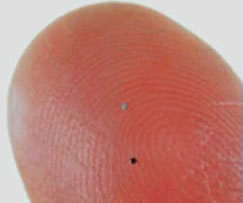
The world's smallest and thinnest RFID tags were introduced by Hitachi. Tiny miracles of miniaturization, these RFID chips (Radio Frequency IDentification chips) measure just 0.05 x 0.05 millimeters.

The previous record-holder, the Hitachi mu-chip, is just 0.4 x 0.4 millimeters. Take a look at the size of the mu-chip RFID tag on a human fingertip. That is 60 times BIGGER than the new Hitachi chips.

Wednesday, September 2, 2009

After the Transistor, a Leap Into the Microcosm - NYTimes.com

After the Transistor, a Leap Into the Microcosm - NYTimes.com: "Dr. Ross, an I.B.M. researcher, is growing a crop of mushroom-shaped silicon nanowires that may one day become a basic building block for a new kind of electronics. Nanowires are just one example, although one of the most promising, of a transformation now taking place in the material sciences as researchers push to create the next generation of switching devices smaller, faster and more powerful than today’s transistors."

"The reason that many computer scientists are pursuing this goal is that the shrinking of the transistor has approached fundamental physical limits. Increasingly, transistor manufacturers grapple with subatomic effects, like the tendency for electrons to “leak” across material boundaries. The leaking electrons make it more difficult to know when a transistor is in an on or off state, the information that makes electronic computing possible. They have also led to excess heat, the bane of the fastest computer chips."

Thursday, June 25, 2009

Robot Surgeon Finds Tiny Shrapnel: Discovery Channel

Robot Surgeon Finds Tiny Shrapnel: Discovery Channel: "A robotic surgeon at Duke University has successfully found and guided a needle to a sliver of steel shrapnel, completely without human help. The technology could reduce the cost and time necessary to complete a biopsy and other surgical operations."

Wednesday, October 22, 2008

Robotic ants building homes on Mars?


ICT Results -- cordis.europa.eu Robotic ants building homes on Mars?: "Recent discoveries of water and Earth-like soil on Mars have set imaginations running wild that human beings may one day colonise the Red Planet. However, the first inhabitants might not be human in form at all, but rather swarms of tiny robots.

“Small robots that are able to work together could explore the planet. We now know there is water and dust so all they would need is some sort of glue to start building structures, such as homes for human scientists,” says Marc Szymanski, a robotics researcher at the University of Karlsruhe in Germany.

Szymanski is part of a team of European researchers developing tiny autonomous robots that can co-operate to perform different tasks, much like termites, ants or bees forage collaboratively for food, build nests and work together for the greater good of the colony."

Friday, January 18, 2008

Contact lenses with circuits, lights a possible platform for superhuman vision


University of Washington News and Information Contact lenses with circuits, lights a possible platform for superhuman vision: "Engineers at the University of Washington have for the first time used manufacturing techniques at microscopic scales to combine a flexible, biologically safe contact lens with an imprinted electronic circuit and lights.

'Looking through a completed lens, you would see what the display is generating superimposed on the world outside,' said Babak Parviz, a UW assistant professor of electrical engineering. 'This is a very small step toward that goal, but I think it's extremely promising.'"

Saturday, September 1, 2007

IBM measures single-atom memory, molecular switch


EETimes.com IBM measures single-atom memory, molecular switch: "Even the highest density hard-disk drives use approximately 1 million magnetic atoms to store a single bit of information. IBM's Almaden Research Center (San Jose, Calif.) has measured the ability to store a bit on a single atom, portending hard drives with ultra-high storage capacity."

"Simultaneously, IBM's Zurich Research Lab has demonstrated a molecular switch that could replace current silicon-based chip technology with processors so small that a supercomputer could fit on a chip the size of a speck of dust."

Monday, August 20, 2007

Scientists Train Nano-'Building Blocks' to Self Assemble


Medgadget Scientists Train Nano-'Building Blocks' to Self Assemble: "Researchers from the University of Delaware and Washington University in St. Louis have figured out how to train synthetic polymer molecules to behave--to literally 'self-assemble' --and form into long, multicompartment cylinders 1,000 times thinner than a human hair, with potential uses in radiology, signal communication and the delivery of therapeutic drugs in the human body."

Tuesday, August 7, 2007

Miniature Implanted Devices Could Treat Epilepsy, Glaucoma


ScienceDaily Miniature Implanted Devices Could Treat Epilepsy, Glaucoma: "Purdue University researchers have developed new miniature devices designed to be implanted in the brain to predict and prevent epileptic seizures and a nanotech sensor for implantation in the eye to treat glaucoma."

"The transmitter consumes 8.8 milliwatts, or about one-third as much power as other implantable transmitters while transmitting 10 times more data. Another key advantage is that the transmitter has the capacity to collect data specifically related to epileptic seizures from 1,000 channels, or locations in the brain"

Also reported on MedGadget

Friday, February 23, 2007

World's tiniest RFID tag unveiled


BBC NEWS: "The world's smallest radio frequency identification tags have been unveiled by Japanese electronics firm Hitachi. The minute devices measure just 0.05mm by 0.05mm (0.002x0.002in) and to the naked eye look like spots of powder. They are thin enough to be embedded in a sheet of paper, Hitachi spokesman Masayuki Takeuchi says."

See some potential for ubiquitous computing?