Showing posts with label interfaces. Show all posts

Friday, September 16, 2011

Adapting to the iPad, called education's 'equalizer'

From USATODAY.com
Image source: USA Today

Well-designed interfaces can open the world to people.
"The 18-year-old is a quadriplegic with multiple disabilities that make speech and muscle control extremely difficult. He interacts through eye gaze or by tapping his head against a switch on a communication device to spell out words.
But on a recent afternoon at the Lehmann Center, a special-needs school in Lakewood, N.J., Leuck was able to make music. With some effort, he slid his knuckles lightly over the digital image of a guitar on an iPad screen. The touches produced a series of acoustic-style chords from the iPad — and a big grin from Leuck."

Thursday, September 15, 2011

Robocleaners, tweeting appliances in the home of tomorrow

From USATODAY.com
Image Source: jeffbots.com
"Ever wondered what your home might look like in 10 years' time? Will it be cleaned by robots and run by computers? Will your fridge go online to allow you to discuss dinner plans with your spouse or instruct it to do the shopping?"
"If the technology giants exhibiting their latest wares at the recent IFA trade fair in Berlin are to be believed, this is what life could be like. The technology exists, even if some of the products have so far only been launched in places like Korea, one of the world's leading consumer electronics markets."

Friday, August 26, 2011

A Day Made of Glass

From Corning.

This video shows some cool possibilities for near future tech. It's more than five minutes long, but engaging and worth it.


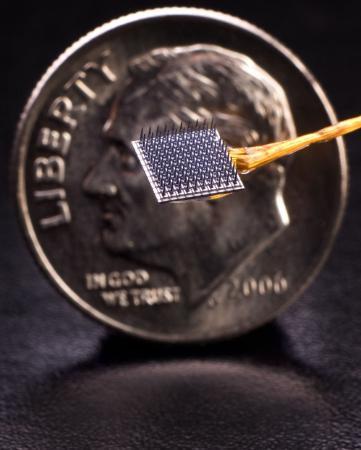
BrainGate neural interface system reaches 1,000-day performance milestone

From Brown University News and Events

Image Source: Brown Univ
An interesting milestone in machine/human integration. The system described is being used to replace functionality lost to tetraplegia, but as with any such system, it could someday be used to give unimpaired people extra abilities.
"An investigational implanted system being developed to translate brain signals toward control of assistive devices has allowed a woman with paralysis to accurately control a computer cursor at 2.7 years after implantation, providing a key demonstration that neural activity can be read out and converted into action for an unprecedented length of time."

"Under development since 2002, the investigational BrainGate system is a combination of hardware and software that directly senses electrical signals produced by neurons in the brain that control movement. By decoding those signals and translating them into digital instructions, the system is being evaluated for its ability to give people with paralysis control of external devices such as computers, robotic assistive devices, or wheelchairs. The BrainGate team is also engaged in research toward control of advanced prosthetic limbs and toward direct intracortical control of functional electrical stimulation devices for people with spinal cord injury, in collaboration with researchers at the Cleveland FES Center."

Thursday, June 16, 2011

Integrating humans with machines

As prosthetics become more and more sophisticated, one of the major challenges is the mind-machine interface. In the past we've relied on rather crude signaling methods, but continuing advances bring us closer to true replacements. And once we can replace natural function, it's a short hop to enhancing natural function. Perhaps a boutique at the mall where you can pick out new arms and have them cut off your old ones?

Wednesday, September 15, 2010

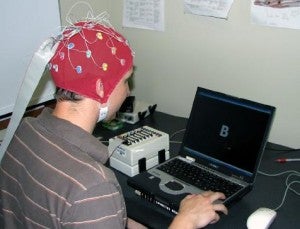
Songs in the key of EEG

See original article at CultureLab

Brain-computer interfaces have been researched and developed for all kinds of practical reasons; here's an example of an artistic application.
"Mick Grierson of Goldsmiths College, London, developed a program that allows a computer to read music from your mind. Think of a note, and the computer will play it back. It wasn't perfectly accurate, but it was good enough to get Peters' attention."

Saturday, February 13, 2010

Will Keyboards give way to Brain Control Interfaces?

Mind Over Matter... ExtremeTech

I remember sitting in typing class back in high school, wondering "when in the world am I ever going to use this skill?" I couldn't have envisioned how computers would change things.

Despite the rapid advancement of computers, a few elements have remained near universal: display screen, keyboard, pointing device. These components have been such an integral part of computing since early days that it's hard to imagine a computer without them. Prediction: this is certainly going to change. Some new input technology will come along and keyboards will go the way of rotary-dialed phones. We don't know yet what that new technology will be, but it's coming.

An intriguing possibility: direct brain interfaces. If we could master two-way neural/electronic interfaces, we could get rid of all three: keyboard, mouse, AND monitor.
"The ability to influence the physical world merely by thought has been a dream of mankind for many years. Now researchers are making real progress in letting people control a PC simply by thinking, and the first crop of consumer Brain Control Interface (BCI) headsets has arrived. Right now these are being used only for simple games, and hardware and applications to support the technology are scarce. But this still represents a major advance that could significantly change how we all interact with computers."

As the story goes on to describe, a natural application of brain control interfaces (BCIs) is to replace lost functionality in people who have suffered loss of motor control. Once BCIs can be used replace lost functionality, it's almost inevitable that they will be used to introduce new functionality -- built-in GPS, anyone? Human calculators? Eidetic memory? Why not control the world around you with a mere thought? Turn lights on and off. Set the thermostat. Change the channels. Sounds spurious? Maybe. But how many of today's conveniences would have sounded the same to earlier generations?

Thursday, February 11, 2010

The Emotional Computer

Can your computer make you happy?

Researchers in the Affective Computing Group at the MIT Media Lab are trying to improve your computer by giving it emotions -- or rather, the ability to detect them. Plenty of people get mad at their computers. What if the computer could sense that, and respond by changing the way it worked?
"We're not talking about handing a global missile defence system over to a PC with a lot of feelings, but we are talking about improving the interface between humans and computers by making computers easier and more intuitive to interact with. For example, computers that sense when a user is getting frustrated could try a different way of explaining how to troubleshoot the internet connection. Cars that can tell when a driver is about to fall asleep could sound an alarm."

"The laboratory for Affective Computing at The Massachusetts Institute of Technology puts it like this: "Emotion is fundamental to human experience, influencing cognition, perception, and everyday tasks such as learning, communication, and even rational decision-making. However, technologists have largely ignored emotion and created an often-frustrating experience for people, in part because affect has been misunderstood and is hard to measure."

At some point in the future, will your computer get mad at you for the way you're acting? We'll have to wait and see.

Wednesday, February 3, 2010

Mind-reading in consumer devices

Mind-control mobile-phone games Anyone ready for a driect brain interface?

"Mobile-games researcher Dr Paul Coulton and PhD student Will Bamford of InfoLab21 recently unveiled their new game ‘Brain Maze’, in which players use ‘tilt’ controls and a brain-wave reading headset to progress a marble around a course.

"At key checkpoints around the maze, the accelerometer-equipped phone picks up electromagnetic waves from the player’s brain - ‘Brain Maze’ uses alpha waves, which are associated with a meditative state, and beta waves, which are associated with an attentive state, to control access through the ‘mind gates’ that form part of the game."

The game is controlled by NeuroSky’s MindSet brainwave-interface headset, which retails for just $199.

Friday, January 15, 2010

Reading Your Mind to Tag Images


Reading Your Mind...: "The most valuable machine you own may be between your ears. Work done at Microsoft Research is using electroencephalograph (EEG) measurements to “read” minds in order to help tag images. When someone looks at an image, different areas of their brain have different levels of activity. This activity can be measured and scientists can reasonably determine what the person is looking at. It only takes about half a second to read the brain activity associated with each image, making the EEG process much faster than traditional manual tagging. The “mind-reading” technique may be the first step towards a hybrid system of computer and human analysis for images and many other forms of data."

Wednesday, September 2, 2009

Exoskeletons enhance natural physical abilities

August 2009 Newsletter | CITRIS: "In the 1986 sci-fi classic Aliens, Sigourney Weaver’s character defeats her nemesis with a huge exoskeleton device that she operates from inside with buttons and a joystick. Twenty-two years later, Tony Stark steps inside Iron Man, a much sleeker and more agile version of a wearable robot. How was Iron Man manipulated? Possibly with sensors that could read electrical signals coming from the brain with an EEG-like device embedded in the helmet or implanted into the motor cortex of the brain. Or maybe it was a simpler touch interface that would simply read the contact force applied by the body itself and amplify or convert its motions into movement of the robotic exoskeleton."

"All of those approaches are feasible and, in fact, being investigated or implemented by engineers around the world in efforts to explore alternative ways to operate the coming generation of wearable machines."

Sunday, May 31, 2009

The Grill: Dawn M. Taylor on brain-computer interfaces

The Grill: Dawn M. Taylor on brain-computer interfaces: "What are you doing at the FES Center? The goal at the center is to restore movement and function to people with paralysis from spinal cord injury, stroke or other neurological disorders. Movement is restored by applying low levels of electrical current to the peripheral nerves to activate paralyzed muscles. My particular role is to decode one's intended arm and hand movements from the brain. Basically, we are reconnecting the brain to the muscles so people can control their paralyzed limb just by thinking about doing so. Intended movements can also be used to control other technologies, such as prosthetic limbs, assistive robots or a computer mouse."

Friday, April 24, 2009

Just think to tweet!

Researchers use brain interface to post to Twitter (April 20, 2009): "In early April, Adam Wilson posted a status update on the social networking Web site Twitter — just by thinking about it.

Just 23 characters long, his message, 'using EEG to send tweet,' demonstrates a natural, manageable way in which 'locked-in' patients can couple brain-computer interface technologies with modern communication tools."

Friday, September 26, 2008

Robot assistant gives surgeons a cutting look

New Scientist Tech 24 September 2008 Robot assistant gives surgeons a cutting look: "The surgeon's eyes dart to the left, and instantly a robotic laser shifts position and gets to work on a new section of tissue. No, this is not telekinesis, but a new eye-tracking technology that could soon be giving surgeons a hand during tricky procedures.

"The device has been integrated into a da Vinci surgical robot - a tool that allows surgeons to perform keyhole procedures by mimicking their hand movements. However, according to a team from the Hamlyn Centre for Robotic Surgery at Imperial College London, surgeons often need more than two hands when it comes to positioning additional instruments such as endoscopes or lasers."

Tuesday, August 26, 2008

'Frankenrobot' Has Biological Brain

Discovery News "Meet Gordon, probably the world's first robot to be controlled exclusively by living brain tissue.

"Stitched together from cultured rat neurons, Gordon's primitive grey matter was designed at the University of Reading by scientists who unveiled the neuron-powered machine on Wednesday.

"Their groundbreaking experiments explore the vanishing boundary between natural and artificial intelligence, and could shed light on the fundamental building blocks of memory and learning, one of the lead researchers said."

Wednesday, September 26, 2007

NASA Tests Robot Surgeon for Missions to Moon, Mars

Scientific American NASA Tests Robot Surgeon for Missions to Moon, Mars: "As NASA sets its sites on manned missions back to the moon and as far away as Mars, the space agency is participating a series of tests this week to determine if robotic technology is the key to providing adequate medical care for its astronauts during such extended spaceflights."

Saturday, September 8, 2007

The trouble with computers


Economist.comThe trouble with computers: "Many futurists and computer experts believe that the logical conclusion of all of these new input devices, sensors and smarter software to anticipate users' needs, will be for computing to blend into the background. In this “ubiquitous computing” model, computers will no longer be things people use explicitly, any more than they “use” electricity when turning on a light or a radio. Mr Greenfield says a digital “dream world” that provides “one seamless experience of being immersed in information” hinges on one big if: computers and their interfaces must become so good that, like electricity, they rarely require concentrated attention. The trouble with computers in their current form is that they are still all too conspicuous."

An interesting article on the importance of HCI -- processing power alone won't take us far, without good user interfaces.

Saturday, February 10, 2007

Computers Read Your Intentions

FOXNews.com: "New experiments show it is possible for computers to detect, at a higher level of sophistication than ever before, people's intentions for the future, neuroscientists reported yesterday.

The findings could yield a big improvement in brain-computer interfaces, could help the disabled control robotics with their minds and could make it so a computer could read our minds far better than is currently possible."

Wednesday, January 31, 2007

Brain Implant to Explore Consciousness

Technology Review : "Bill Newsome, a neuroscientist at Stanford University in Palo Alto, CA, has spent the last twenty years studying how neurons encode information and how they use it to make decisions about the world. In the 1990s, he and collaborators were able to change the way a monkey responded to its environment by sending electric jolts to certain parts of its brain. The findings gave neuroscientists enormous insight into the inner workings of the brain.

But Newsome is obsessed with a lingering question: How does consciousness arise from brain function? He feels the best way to answer that question is by implanting an electrode into his own brain -- and seeing how the electric current changes his perception of the world."

One step beyond what Kevin Warwick is doing, into the emerging field of "cognotechnology."

Tuesday, January 30, 2007

Kevin Warwick

Home Page: "Kevin has carried out a series of pioneering experiments involving the neuro-surgical implantation of a device into the median nerves of his left arm in order to link his nervous system directly to a computer in order to assess the latest technology for use with the disabled. He has been successful with the first extra-sensory (ultrasonic) input for a human and with the first purely electronic communication experiment between the nervous systems of two humans."

Kevin's research obviously has great potential for restoring sensation and mobility in patients with damage to the nervous system; equally obvious are the ethical and social issues that arise. "Kevin is currently working closely with Dr Daniela Cerqui, a social and cultural anthropologist to address the main social, ethical, philosophical and anthropological issues related to his research into robotics and cyborgs."