Showing posts with label ubiquitous computing. Show all posts

Thursday, September 15, 2011

Robocleaners, tweeting appliances in the home of tomorrow

From USATODAY.com
Image Source: jeffbots.com
"Ever wondered what your home might look like in 10 years' time? Will it be cleaned by robots and run by computers? Will your fridge go online to allow you to discuss dinner plans with your spouse or instruct it to do the shopping?"
"If the technology giants exhibiting their latest wares at the recent IFA trade fair in Berlin are to be believed, this is what life could be like. The technology exists, even if some of the products have so far only been launched in places like Korea, one of the world's leading consumer electronics markets."

Monday, September 5, 2011

SignalGuru - a high-tech way to avoid red lights

Image Source: gizmag.com
From gizmag.com

Driving is yet another activity being totally transformed by technology. I always check my iPhone before heading across the Susquehanna to figure out if it's worth it to take the Turnpike (and avoid the 83 traffic). This story describes a system to help drivers avoid red lights.

"One of the most effective hypermiling techniques is maintaining a steady speed while driving instead of constantly stopping and starting. Unfortunately, traffic lights all too often conspire to foil attempts at keeping the vehicle rolling. Researchers at MIT and Princeton have now devised a system that gathers visual data from the cameras of a network of dashboard-mounted smartphones and tells drivers the optimal speed to drive at to avoid waiting at the next set of lights."

"The new system, dubbed SignalGuru, was tested in both Cambridge, Massachusetts, and in Singapore. In Cambridge, where traffic signals are on fixed schedules, the researchers say the system was able to predict when lights would change with an average error of only two-thirds of a second and helped drivers cut fuel consumption by an average of 20 percent. "

Sunday, August 28, 2011

Data are traveling by light

From Fraunhofer-Gesellschaft

My favorite part of the article: the use of the word "ensconced." A visible light WLAN might be kind of impressive, but if the users are also ENSCONCED in a room, well then that's just amazing!

Joking aside, this is an interesting approach to networking that doesn't rely on traditional radio signals.
"Just imagine the following scenario: four people are comfortably ensconced in a room. Each one of them can watch a film from the Internet on his or her laptop, in HD quality. This is made possible thanks to optical WLAN. Light from the LEDs in the overhead lights serves as the transfer medium."

'via Blog this'

Saturday, August 27, 2011

How 5 Recent Social Uprisings Were Wired

From Scientific American


Iran, Tunisia, Egypt, China -- modern day revolutions are relying on wired technologies.
"From the horseback ride of Paul Revere—and for millennia before—people have used the latest technology available to rally others sympathetic to their cause. As ubiquitous as Twitter and Facebook have seemed lately in spreading the word for gatherings, whether benevolent or malevolent, many recent demonstrations and revolts have used a variety of primarily digital platforms to spread their message. Here are five examples in just the past two years:"

Friday, August 26, 2011

A Day Made of Glass

From Corning.

This video shows some cool possibilities for near future tech. It's more than five minutes long, but engaging and worth it.


Monday, September 27, 2010

Cars as traffic sensors

Image: Google
See original story at MIT News -- Cars as traffic sensors

A great example of how ubiquitous networked processors can function together as a single sensor network.
"Data about road and traffic conditions can come from radio stations’ helicopters, the Department of Transportation’s roadside sensors, or even, these days, updates from ordinary people with cell phones. But all of these approaches have limitations: Helicopters are costly to deploy and can observe only so many roads at once, and it could take a while for the effects of congestion to spread far enough that a road sensor will detect them."
"MIT’s CarTel project is investigating how cars themselves could be used as ubiquitous, highly reliable mobile sensors."

Thursday, February 18, 2010

Dubai Assassination Caught on Surveillance

Big news this week was the assassination of a Hamas official in Dubai by a team of more than 10 assassins. What was particularly striking to me was how much of the unfolding event was captured on surveillance video. I've often asked my students how much of their lives they think is captured on video -- certainly not as much as in a place like Dubai. But whatever amount it is, it will only be increasing.

There are at least two significant issues this raises: first is the social issue of privacy. It's not exactly that surveillance makes private things public; however it does turns public events that would have been transient into permanent records. What will the social cost be?

Second is the technological issue of how to deal with the deluge of data. Not just how to store it, but what to do with it. Imagine a day when intelligent software can monitor the massive flow of data from ubiquitous video, audio, and other sensors. Will we be able to prevent crimes and terrorist acts by catching the would-be perpetrators in advance? Starting to sound a bit like "Minority Report!"

Image credit: http://blogs.edweek.org/edweek/LeaderTalk/

Wednesday, October 22, 2008

Robotic ants building homes on Mars?


ICT Results -- cordis.europa.eu Robotic ants building homes on Mars?: "Recent discoveries of water and Earth-like soil on Mars have set imaginations running wild that human beings may one day colonise the Red Planet. However, the first inhabitants might not be human in form at all, but rather swarms of tiny robots.

“Small robots that are able to work together could explore the planet. We now know there is water and dust so all they would need is some sort of glue to start building structures, such as homes for human scientists,” says Marc Szymanski, a robotics researcher at the University of Karlsruhe in Germany.

Szymanski is part of a team of European researchers developing tiny autonomous robots that can co-operate to perform different tasks, much like termites, ants or bees forage collaboratively for food, build nests and work together for the greater good of the colony."

Tuesday, August 26, 2008

How RFID Tags Could Be Used to Track Unsuspecting People

Scientific American. Radio-frequency identi­fication (RFID) tags are embedded in a growing number of personal items and identity documents.Because the tags were designed to be powerful tracking devices and they typically incorporate little security, people wearing or carrying them are vulnerable to surreptitious surveillance and profiling..."

"If you live in a state bordering Canada or Mexico, you may soon be given an opportunity to carry a very high tech item: a remotely readable driver’s license. Designed to identify U.S. citizens as they approach the nation’s borders, the cards are being promoted by the Department of Homeland Security as a way to save time and simplify border crossings. But if you care about your safety and privacy as much as convenience, you might want to think twice before signing up."

RFID--A Key to Automating Everything: Scientific American

"Thirteen years ago, in an article for Scientific American, the late Mark Weiser, then my colleague at Xerox PARC, outlined his bold vision of “ubiquitous computing”: small computers would be embedded in everyday objects all around us and, using wireless connections, would respond to our presence, desires and needs without being actively manipulated. This network of mobile and fixed devices would do things for us automatically and so invisibly that we would notice only their effects. Weiser called such systems “calm technology,” because they would make it easier for us to focus on our work and other activities, instead of demanding that we interact with and control them, as the typical PC does today.

"Today systems based on radio-frequency identification (RFID) technology are helping to move Weiser’s vision closer to reality. These systems consist of tags (small silicon chips that contain identifying data and sometimes other information) and of readers that automatically receive and decode that data.

Saturday, September 8, 2007

The trouble with computers


Economist.comThe trouble with computers: "Many futurists and computer experts believe that the logical conclusion of all of these new input devices, sensors and smarter software to anticipate users' needs, will be for computing to blend into the background. In this “ubiquitous computing” model, computers will no longer be things people use explicitly, any more than they “use” electricity when turning on a light or a radio. Mr Greenfield says a digital “dream world” that provides “one seamless experience of being immersed in information” hinges on one big if: computers and their interfaces must become so good that, like electricity, they rarely require concentrated attention. The trouble with computers in their current form is that they are still all too conspicuous."

An interesting article on the importance of HCI -- processing power alone won't take us far, without good user interfaces.

Friday, February 23, 2007

World's tiniest RFID tag unveiled


BBC NEWS: "The world's smallest radio frequency identification tags have been unveiled by Japanese electronics firm Hitachi. The minute devices measure just 0.05mm by 0.05mm (0.002x0.002in) and to the naked eye look like spots of powder. They are thin enough to be embedded in a sheet of paper, Hitachi spokesman Masayuki Takeuchi says."

See some potential for ubiquitous computing?

Monday, February 19, 2007

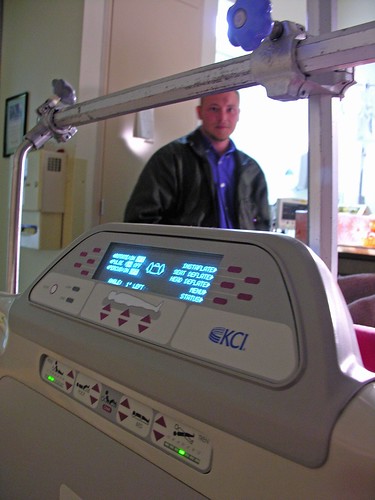
Open Communication Among Operating Room Equipment


ScienceDaily — "New research at the University of New Hampshire aims to make hospital operating rooms safer by opening the lines of communication between computerized hospital beds and blood pressure monitors."

"We’re trying to get pieces of equipment that don’t normally talk to each other to do so," says John LaCourse, professor of electrical and computer engineering at UNH. "We’re doing something that we feel is going to save peoples’ lives."

"In modern operating rooms, major pieces of equipment like beds and monitors are computerized, yet they lack the ability to share information with each other. When a bed is raised or lowered, for instance, a patient’s blood pressure fluctuates but the monitor, which is static, may give a faulty reading."