Showing posts with label prosthetics. Show all posts

Friday, September 16, 2011

Adapting to the iPad, called education's 'equalizer'

From USATODAY.com
Image source: USA Today

Well-designed interfaces can open the world to people.
"The 18-year-old is a quadriplegic with multiple disabilities that make speech and muscle control extremely difficult. He interacts through eye gaze or by tapping his head against a switch on a communication device to spell out words.
But on a recent afternoon at the Lehmann Center, a special-needs school in Lakewood, N.J., Leuck was able to make music. With some effort, he slid his knuckles lightly over the digital image of a guitar on an iPad screen. The touches produced a series of acoustic-style chords from the iPad — and a big grin from Leuck."

Friday, August 26, 2011

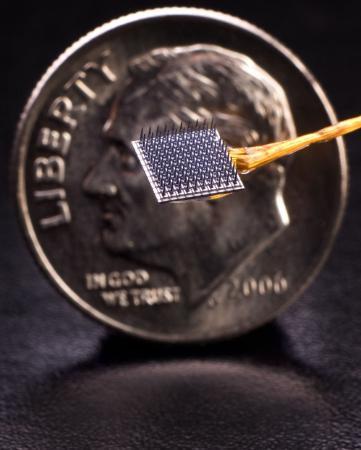
BrainGate neural interface system reaches 1,000-day performance milestone

From Brown University News and Events

Image Source: Brown Univ
An interesting milestone in machine/human integration. The system described is being used to replace functionality lost to tetraplegia, but as with any such system, it could someday be used to give unimpaired people extra abilities.
"An investigational implanted system being developed to translate brain signals toward control of assistive devices has allowed a woman with paralysis to accurately control a computer cursor at 2.7 years after implantation, providing a key demonstration that neural activity can be read out and converted into action for an unprecedented length of time."

"Under development since 2002, the investigational BrainGate system is a combination of hardware and software that directly senses electrical signals produced by neurons in the brain that control movement. By decoding those signals and translating them into digital instructions, the system is being evaluated for its ability to give people with paralysis control of external devices such as computers, robotic assistive devices, or wheelchairs. The BrainGate team is also engaged in research toward control of advanced prosthetic limbs and toward direct intracortical control of functional electrical stimulation devices for people with spinal cord injury, in collaboration with researchers at the Cleveland FES Center."

Thursday, June 16, 2011

Integrating humans with machines

As prosthetics become more and more sophisticated, one of the major challenges is the mind-machine interface. In the past we've relied on rather crude signaling methods, but continuing advances bring us closer to true replacements. And once we can replace natural function, it's a short hop to enhancing natural function. Perhaps a boutique at the mall where you can pick out new arms and have them cut off your old ones?

Saturday, November 8, 2008

Honda Unveils Robot That Helps You Walk


FOXNews.com One of the first commercial applications of what I expect will be a growing field of assistive prosthetics: "Imagine a bicycle seat connected by mechanical frames to a pair of shoes for an idea of how the new wearable assisted-walking gadget from Honda works.

The experimental device, unveiled Friday, is designed to support bodyweight, reduce stress on the knees and help people get up steps and stay in crouching positions."

Tuesday, August 7, 2007

Miniature Implanted Devices Could Treat Epilepsy, Glaucoma


ScienceDaily Miniature Implanted Devices Could Treat Epilepsy, Glaucoma: "Purdue University researchers have developed new miniature devices designed to be implanted in the brain to predict and prevent epileptic seizures and a nanotech sensor for implantation in the eye to treat glaucoma."

"The transmitter consumes 8.8 milliwatts, or about one-third as much power as other implantable transmitters while transmitting 10 times more data. Another key advantage is that the transmitter has the capacity to collect data specifically related to epileptic seizures from 1,000 channels, or locations in the brain"

Also reported on MedGadget